As spring starts to creep up on us in the Piedmont of North Carolina, our cool season forages are starting to emerge from dormancy and grow. This article will cover some management decisions to consider now through late spring/early summer to help maximize yield and promote overall forage, soil, and animal health.
If you haven't been out in your pastures, now is a great time to check on the condition of your pastures and forages. The biggest thing to consider is that forages have to have rest to be productive and grow. In some cases, it may be necessary to continue to feed hay in a sacrificial pasture during the green up period, just to ensure that your forages have enough regrowth to start grazing (minimum of 6-8 inches). Pastures that have been overgrazed this winter will require more time for regrowth compared to pastures that have been left with more plant residual. Multi-paddock/pasture systems or the use of temporary fencing will play a huge role in promoting forage rest.
Now is also the optimal time to apply fertilizers, whether commercial fertilizer or chicken litter. Although phosphorus and potassium are critical nutrients to apply and monitor, nitrogen (N) is what we will focus on in this article. Before we dive into fertilizers, remember to take a soil test every 2-3 years to know what and how much nutrients to apply.
Nitrogen is arguably the most critical nutrient since it is responsible for increasing yields, crude protein and palatability in forages. Nitrogen can also be limiting since it is quickly used in plants and pastures can be deficient of N. Good grazing management can help with keeping N recycled in pastures.
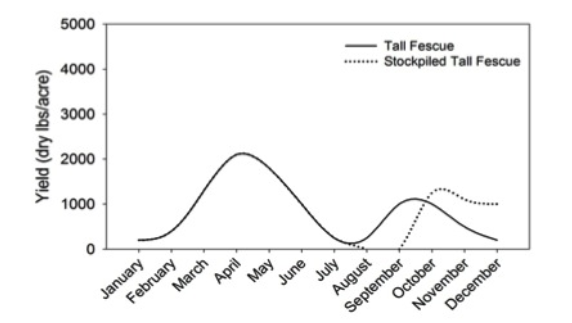
When using the NC Department of Agriculture’s soil testing lab, remember that N is not tested for. They provide a text book recommendation. For tall fescue that recommendation is 120-240 pounds per acre. When I give fertilizer recommendations, I recommend splitting that rate in half and applying half in the spring and the remaining half in the fall (60-120lbs/acre/application). This way you can potentially increase your yield by matching applications to tall fescues growth curve (see image below from the University of Georgia).
Getting N applied before the peak of the growing season will allow you to maximize the fertilizers potential to increase forage yield. With increased fertilizer prices, this is important to get the most out of your inputs.
Weather plays a huge role with not only plant growth but with N utilization. Rain is another critical player in forage yield. Nitrogen needs rain to get in the soil so that the plant can utilize it. Without rain, N will volatilize into the atmosphere and not get incorporated in the soil to be available to plants. Urea based N fertilizers are the most volatile. Studies have shown that up to 70% N loss can happen within 3 days of applications under certain conditions. The worst conditions for N volatilization are with applications that are made on pastures where soil moisture is high and it is followed by a long period without rain. Other factors that can increase volatilization are sun, heat and wind.
Ensuring good grazing management strategies will also help forage production as well as herd and flock health through the spring. Practicing correct rotational grazing practices will help promote forage rest as well as nutrient recycling through concentrating manure and urine deposits. Remember when grazing, graze the forages down to a minimum of 3-6 inches then move animals to a new paddock or pasture. The more plant residual you leave, the faster the plant will regrow. Overgrazing or clipping pastures too late in the cool season forage growing season, can allow undesirable plants to thrive during the summer. Keeping a good forage cover can help reduce unwanted weeds.
Pay attention to weeds and other undesirable plants. One of the most common calls I get in April and May is “what do I do with the yellow weeds?” Remember that if you are going to apply herbicide to weeds, make the applications early when they are smaller and before they enter their reproduction stage. When herbicide is applied during and after those plants bloom, they are harder to control and the weeds still may produce viable seed for the next year.
When looking at animal health, as cool season forages grow and mature, they will start to go into their reproductive stage and produce seedheads. Seedheads can aggravate animals' eyes causing them to water and attract flies. This can lead to increased pinkeye cases. When looking at forage management, clipping seedheads off can reduce the chances of pinkeye cases. Typically this will become an issue later in the spring leading into summer. One thing to be cautious of when clipping pastures later in the growing season is that the cool season forage growth will start to slow down as summer approaches. Be sure not to clip pastures and try to leave as much of the forage leaves to ensure you have forage to graze during the summer slump of fescue. If you use summer forages to fill the grazing gap in the summer, make sure you are getting your seed now so that you can be ready to plant them come mid spring.
Every livestock and forage operation is not the same and may require different management strategies therefore it is hard to make a blanket management plan. If you have specific questions or would like to schedule a farm visit to work though what you can do to improve your pastures and forages, feel free to reach out to me. I can be reached via phone at 336-318-6012 or by email at adam_lawing@ncsu.edu.
Check out the forage management calendar I created here for additional information.