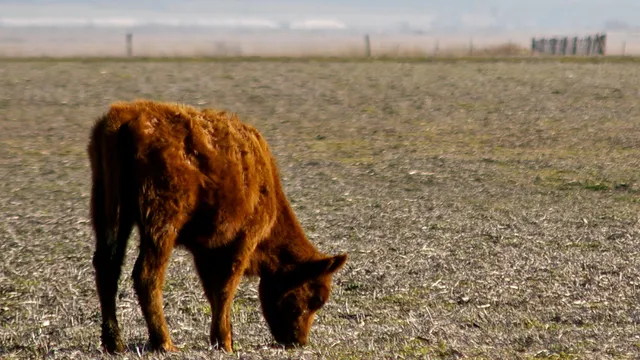
If it doesn't rain soon things will likely more rapidly worsen for grasslands in our state. Many land and livestock managers are already thinking about what to do with pastures that were fertilized in anticipation of rain that never came (see pictures attached I took yesterday, 4/22, for tall fescue pastures in the Piedmont). Although there is grazable forage, likely there will be very high nitrate concentration in the tissue (notice the green dark color in the background hay field, and the dark green spots where urine was deposited in the front of the picture where pastures were not fertilized and grazed earlier this year). Fescue-clover mixtures are still holding, but there is a lot of leaf rolling specially for tall fescue showing signs of drought stress.
I want to bring to your attention this publication that provides guidelines for feeding beef when there is risk for high nitrates.
The same concerns will be present for annual cool-season forages like wheat and others, both in the fresh form and in the form hay. If ensiled, then the ensiling process will help reduce the nitrates.
Temperatures will continue to rise as we move into the summer, and in light of the current lack of rainfall, this circumstance begs the question: Should tall fescue pastures be clipped or grazed entering into the summer? My short answer is that clipping or mowing pastures short (as it is usually done) under these circumstances, risks further stressing the tall fescue pastures as we enter the summer. I know there is a need for forage, but forage with very high nitrates is also not the best. Let's keep watching the weather and hopefully things improve.
Last, because of the earlier high temperatures, native warm-season grasses in the Piedmont have really started to grow earlier and are looking really well (so far). Some of those pastures may be about to be ready for grazing. Just want to remind you, for future planning, about this tool in the tool-box to support tall fescue-based livestock systems in our region. We really need to think about diversifying our forage base. We will have a chance to talk about this in the future. For now, let's focus on what is upon us.