Nitrate and Prussic Acid Concerns in Warm Season Forages
Warm-season annuals are a great tool when tall fescue and other cool-season perennials become dormant in the summer. Whether it is a planted sorghum/sudan variety or volunteer johnsongrass (perennial), both can be palatable to livestock and have excellent nutrient values. However, at certain times, they can be a potential risk to livestock due to toxicities. Nitrates and prussic acid accumulation are the two biggest concerns when utilizing warm-season annuals.Nitrate Poisoning
Warm-season annuals have the ability to accumulate nitrates. When the concentration of nitrates becomes too high, they can become deadly. In ruminant animals, the nitrates are converted to nitrite in the rumen. Once it turns to nitrite, it is absorbed into the bloodstream. This becomes an issue because nitrite interferes with blood’s ability to move oxygen. Symptoms can include trembling, staggers, heavy breathing, and frequent urination. A lot of the time, symptoms are missed because death can occur within a couple of hours.Nitrate accumulation can be from heavy nitrogen fertilization followed by a drought. During a period of drought, nitrates are not converted into proteins and other plant nutrients. One thing to note with nitrates is that the levels do not dissipate when the forage is harvested as dry hay. When ensiled, the nitrate levels can be dropped 40-60%.
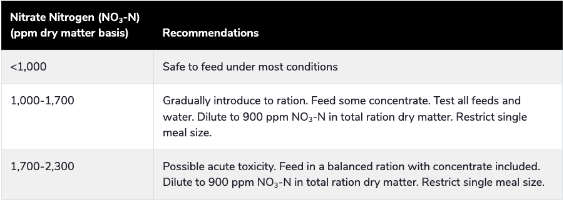
When feeding summer annual forages, it is a good practice to test for nitrates as well as a complete nutrient analysis. The NCDA&CS offers forage testing. Nitrate testing is free all year long and a complete analysis can be done as for $10. The NCDA&CS submission form can be found here. Many private labs can be utilized for forage testing as well.
Below is a chart from Penn State Extension to help determine nitrate levels from a forage analysis: