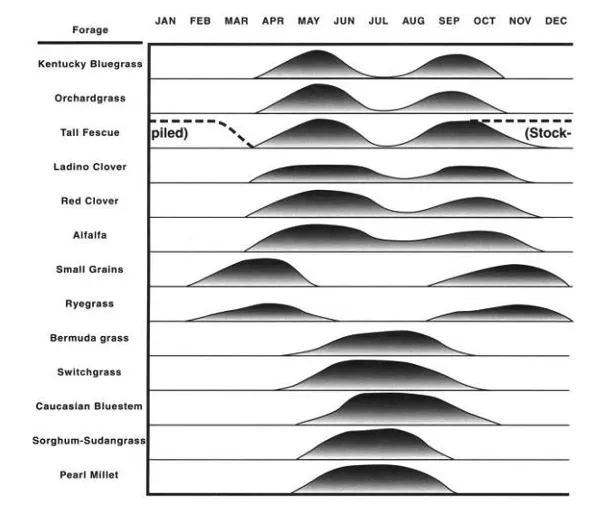
This calendar is designed to give you a baseline and understanding of management practices and when they can be applied. Every operation is different and many practices can be weather dependent. Please reach out or contact your NC Cooperative Extension Office for a personalized management plan as well as weed identification or other assistance if needed. https://www.ces.ncsu.edu/directory/
January
● Calculate financial budget for this coming year's forage operation.
● Look for ideas on reducing costs or increasing income from forages.
● Finish grazing stockpiled pastures.
February
● Order seed and supplies for spring forage seeding.
● Contact local feed and seed stores to get on their fertilizer application list.
● Remove livestock from winter grazing pastures or sacrifice areas to promote forage growth for the spring.
● Begin routine maintenance and repairs on forage planting and harvesting equipment.
● In late February, frost seed legume pastures.
● Plant cool-season forages when soil temperature is 50-60°F and moist enough for germination. https://content.ces.ncsu.edu/planting-guide-for-forage-crops-in-north-carolina
● Apply nitrogen applications late February.
● Apply phosphorus and potassium as needed/shown in the soil report.
● Apply lime as needed/shown in the soil report.
● Spray for cool season weeds such as burdock, buttercups, chickweed, deadnettle, dock, etc. when temperatures are 50-60℉ for several days in a row
March
● Finish frost seeding by early March.
● Begin grazing spring pastures that have enough growth.
● Be aware of grass tetany with rapid grass growth of forages. Supplement with free choice high-magnesium mineral to reduce risk of grass tetany issues.
● Apply nitrogen to grass pastures and hay fields at green-up (if you didn’t apply in February).
● Apply phosphorus and potassium as needed shown in the soil report (if you haven’t already).
● Finish routine maintenance and repairs on forage planting and harvesting equipment.
● Herbicide applications for cool-season weeds (if you didn’t get them in February)
April
● Finish nitrogen applications early for spring green up to maximize investment.
● Be aware of bloat or grass tetany potential and take proper precautions, such as feeding free choice high-magnesium minerals.
● Seed warm-season forages in late April.
● Soil testing with NCDA&CS is no charge until Thanksgiving.
May
● Seed warm-season forages.
● Clip fescue seedheads to prevent pinkeye and help offset fescue toxicosis issues.
● If a surplus of forage is available in pastures, use some of the pastures for hay/haylage production.
● Apply nitrogen to warm-season grass pastures
● Apply phosphorus and potassium to forages after the first harvest according to soil test recommendations.
● Herbicide applications for warm-season weeds
● Cool season forage growth slows down, check forage height to prevent overgrazing.
● Consider where water and shade are in pastures with sun and heat
June
● Graze warm season or summer annual forages as cool season pasture growth slows down.
● Clip mature forages that were not grazed.
● Apply nitrogen applications to warm-season forages.
● Be watchful of nitrate poisoning of livestock grazing summer annuals during drought-damaged forages after rain and highly fertilized summer annuals.
July
● Graze warm season or summer annual forages as cool season forage growth slows down or phases out.
● Purchase cool-season forage seed needed for late August/early September seeding.
● Prepare fields intended for fall seeding.
● Be watchful of nitrate poisoning of livestock grazing summer annuals during drought-damaged forages after rain and highly fertilized summer annuals.
● Clip broomsedge.
August
● Inventory your hay storage. If more hay needs to be purchased, purchase hay before “hay feeding season” starts to ensure you have an ample supply.
● Test hay and silage for forage quality.
● Stop grazing those cool-season forage paddocks that will be stockpiled for grazing in Winter.
● Clip forage paddocks that were not grazed for stockpiled fescue.
● Soil test forage pastures every 3 years
September
● Fall nitrogen applications for cool-season perennials
● Apply nitrogen to stockpiled fescue pastures.
● Apply phosphorus and potassium as needed/shown in the soil report.
● Fertilize hay fields after the final harvest for stand maintenance and winter survival.
● Stop grazing perennial warm-season forages for recovery and winter survival improvement.
● Start planting cool season annuals.
● Sample and test hay and silage for forage quality.
● Soil test forage pastures if not done so
● Clip Broomsedge
October
● Soil test forage pastures if not done so.
● Apply lime now to adjust soil pH according to the soil report.
● Finish planting cool season annuals.
● Be cautious prussic acid poisoning of animals grazing summer annuals and/or Johnsongrass after frost.
November
● Apply fall herbicides for control of winter-annual weeds.
● Consider bale grazing NOW in non-stockpiled pastures if you don’t estimate that you will have enough stockpiled forages to feed through the winter when it’s wet and muddy.
○ OR begin grazing stockpiled forages.
● Do not graze fall planted forages. Wait until forages reach 6-8 inches tall.
● Soil test forage pastures if not done so. NCDA&CS starts charging $5/sample after Thanksgiving.
December
● Continue grazing stockpiled forages.
● Consider bale grazing on poor pastures to help improve soil quality.
● Limit grazing on pastures that have been overgrazed or are below the targeted grazing height, feed hay if necessary.
● Order seed for frost seeding in February and March.
● Calculate expenses and income associated with this past year's forage operation.
● Look back at successes and struggles with your forage program to work on improvements or changes.
● Begin reviewing University and Industry data as to which species and varieties to seed on your farm next year.